












Small-Diameter Silicone Tubing for Precision Applications: Tolerances, Cure Chemistry and Quality Control
Small-Diameter Silicone Tubing for Precision Applications: Tolerances, Cure Chemistry and Quality Control
In a dosing line, a lab analyzer or a compact fluid manifold, the tube is the component everybody sees last and blames first. Ask any OEM engineer what goes wrong with small-diameter flexible silicone tubing and the answer is rarely "the material was wrong." It is that the bore drifted, the wall was not concentric, or an invisible residue migrated into the fluid. Precision, in other words, is manufactured and verified — not specified on a catalog page.
Why "small" makes quality harder, not easier
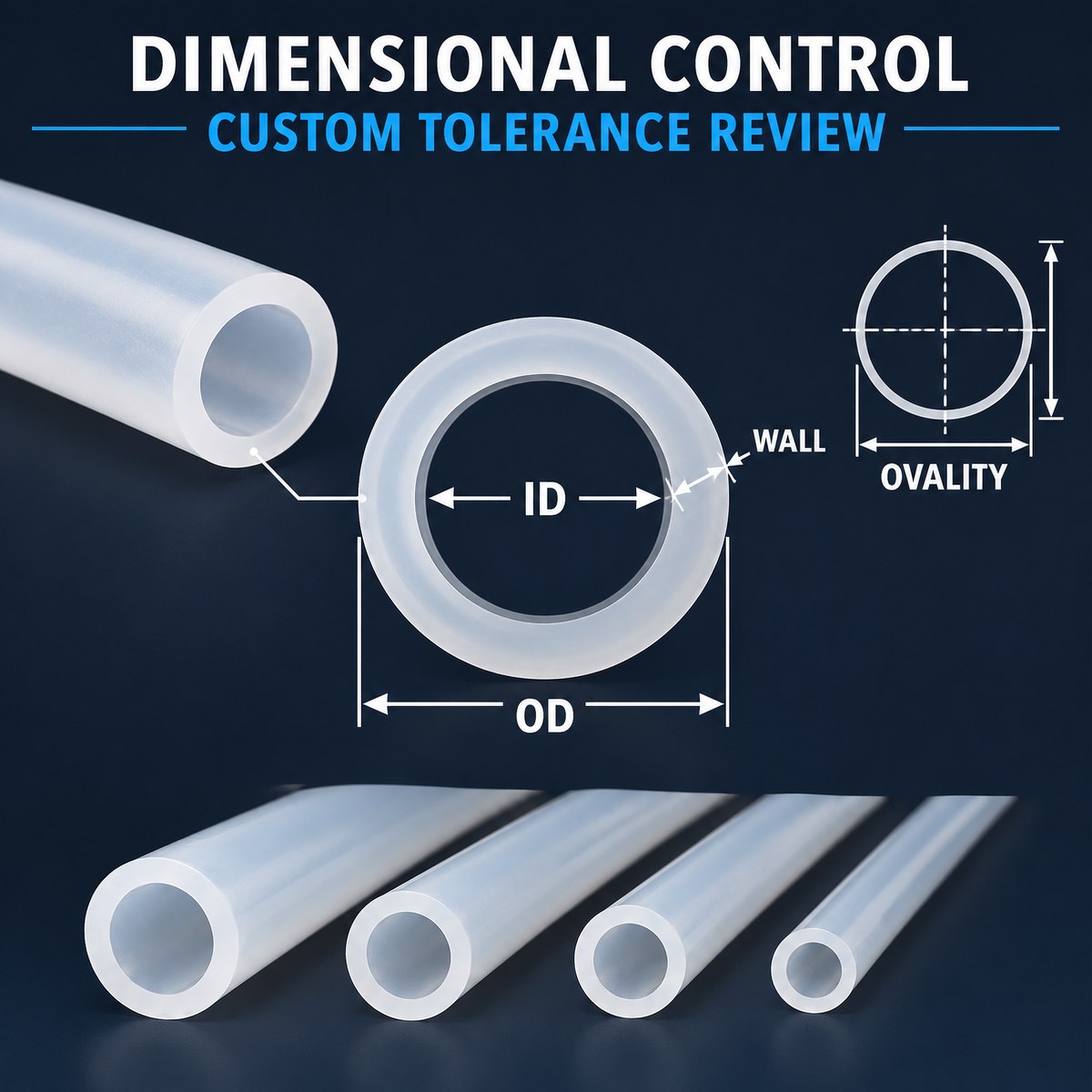
A 1–2 mm inner diameter leaves no room for error to hide. A 0.1 mm deviation in wall thickness is a small number on a caliper but a large change in how a peristaltic pump head compresses the tube — and therefore in delivered volume. Published medical-tubing guidance puts standard inner-diameter and wall tolerance at ±0.1 mm, with precision grade at ±0.05 mm and ovality below 3%; peristaltic service is the reason the tighter figure exists, because pump flow is calibrated against the specified ID and wall [1].
Small bore also magnifies surface effects. A bore that looks smooth can still leach residue or hold microplastic particles; a slightly oval tube can seat badly in a fitting and weep. That is why the acceptance criteria for precision tubing are dimensional and chemical, and why they must be checked batch by batch rather than once at sample stage.
The four dimensions that decide whether your dose is accurate
When we review a drawing at RESRUB, we translate it into four controllable geometric features. Every one of them is measured during the run, not after it:
- Inner diameter. Sets the volume per unit length. Our standard extrusion window is 1–25 mm, with sub-millimeter bore available on request.
- Wall thickness. Sets crush resistance and pump recovery. Typical range 0.3–3.0 mm, held to extrusion tolerance.
- Concentricity / ovality. An off-centre bore changes flow and fitting seal even when average wall is correct.
- Hardness. 30–80 Shore A, customized; it determines how the tube behaves under a roller or around a tight bend.
For context on how far precision extrusion can be pushed: one published medical-tubing line reports ±0.02 mm ID/OD tolerance using vertical extrusion, with a minimum processable ID of 0.14 mm and a wall floor of 0.1 mm in an ISO Class 8 cleanroom [2]. That is not a promise for every compound — it is proof that "tight tolerance" is a process capability you should ask to see evidenced, not a word on a datasheet.
Cure chemistry is a quality decision, not a cost decision
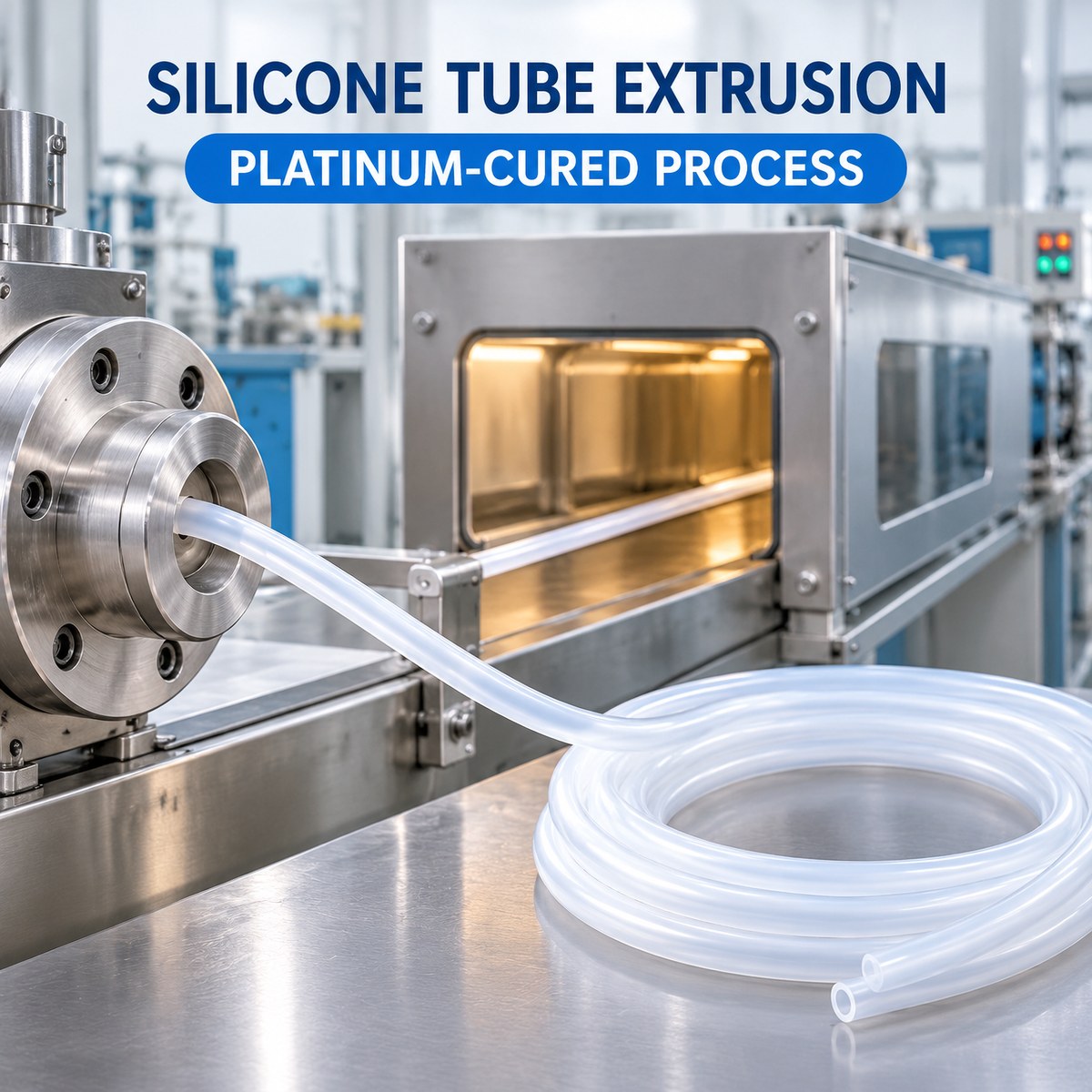
If the fluid touches the bore, the cure system matters more than the brand name. Platinum (addition) cure crosslinks vinyl and hydride siloxane groups without releasing small-molecule by-products; peroxide cure leaves acidic decomposition residues such as benzoic acid or cumyl alcohol that must be driven off with a high-temperature post-cure — commonly cited as around 4 hours at 200 °C [1][3]. Inconsistent post-cure is the classic cause of odour, yellowing and variable extractables.
For that reason, platinum-cured silicone is the default expectation in medical and pharmaceutical fluid paths, and buyers increasingly require the cure system to be stated in writing on the technical data sheet [1][3]. RESRUB offers platinum-cured silicone on request for low-extractable fluid paths; food- and medical-grade options are subject to the specific compound and application, with documentation provided for the grade actually supplied.
Published product data shows the performance envelope buyers benchmark against: platinum-cured pharma tubing in 50/65/80 Shore A with tensile strength around 6.8–8.7 MPa and elongation at break 570–795% [4]; peristaltic-grade platinum silicone at 50/60/65 Shore A with tensile 8.0–8.8 MPa, elongation 400–500% and a stated dimensional tolerance of ISO 3302-1 class E1 [5]. Treat these as reference ranges — the correct value for your line is the one verified on your lot.
What "quality control" should actually mean on a tubing order
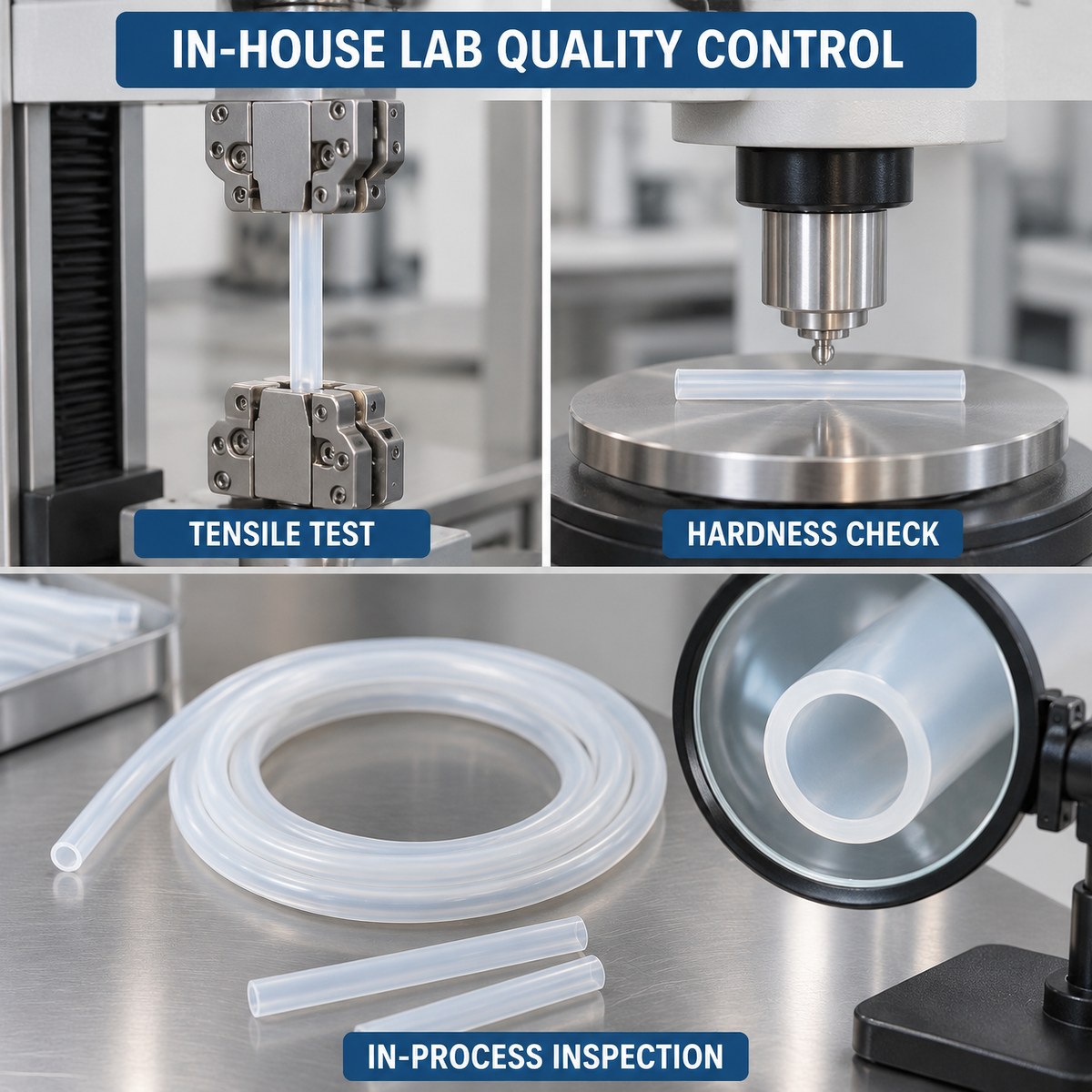
A certificate on the first sample proves very little. Repeatability comes from in-process inspection plus a defined test battery on production lots. At our Dongguan plant, each batch passes through an in-house laboratory for tensile, hardness, tear, heat-aging and ozone testing, with batch-level traceability so you can match a coil back to its production record. The site is certified to IATF 16949:2016, ISO 9001:2015 and ISO 14001:2015, with RoHS and REACH compliance.
Two checks deserve special attention in precision work:
- Dimensional stability after sterilization. Medical-tubing guidance uses ID/OD/wall stability after 100 autoclave cycles at 134 °C as a key validation parameter; gamma at 25–50 kGy is typically accepted with under 10% loss of elongation at the 50 kGy dose [1].
- Clarity as an inspection tool. Transparent platinum-cured grades reaching ≥90% light transmittance at 1.6 mm wall let operators see bubbles, colour shifts and particles in the line [1][6]. On a small-bore path, visual inspection is often the fastest contamination check you have.
If you are new to the process, our companion article How Silicone Tubing Is Made: Extrusion, Curing and Quality Checks walks through the full manufacturing route step by step. This article deliberately goes one level deeper into the tolerances and test evidence that a precision buyer has to defend.
Request the tolerance you need — and the evidence to match
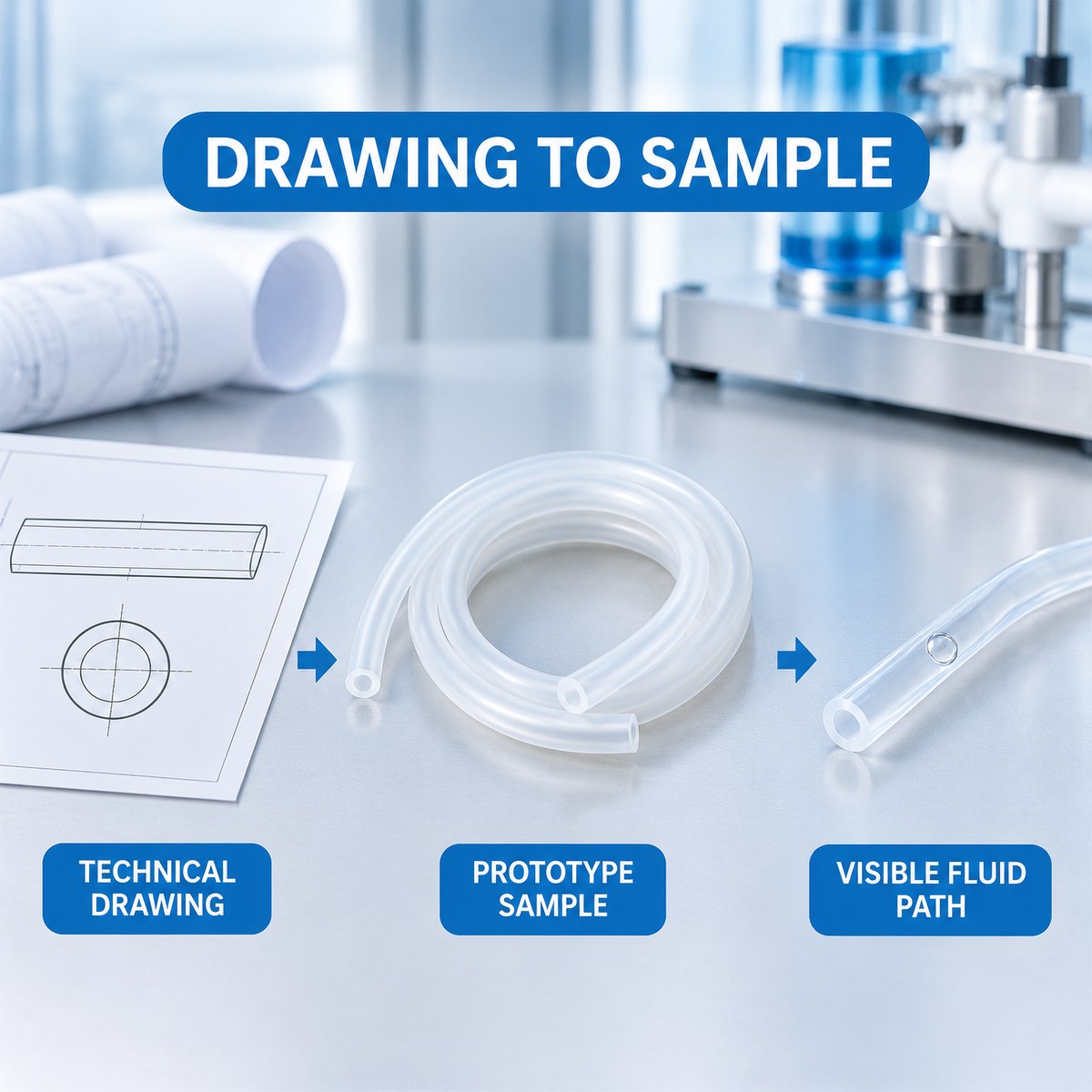
Send a drawing or a sample and we match inner diameter, wall, colour and durometer, then turn it around with 2-hour rapid tooling and free design support. MOQ starts at one piece for standard development work; custom-colour compounds may carry a separate minimum depending on the pigment and grade. Standard packaging is OPP bag, carton or spool/reel, and cut lengths or continuous coils are both available.
The most useful question you can ask a supplier is not "can you do ±0.05 mm?" but "show me how you hold it on production lots." A credible answer includes the measurement method, the sampling interval and a lot-specific certificate of analysis [1]. Our materials and process capabilities page summarises what we can run; the engineering team confirms the exact die and compound for your drawing.
Buyer's acceptance checklist for small-bore silicone tubing
| Check | What to request | Reference point |
|---|---|---|
| ID / wall | State target and tolerance in mm; ask for gauge and sampling interval | ±0.1 mm standard, ±0.05 mm precision [1] |
| Cure system | Platinum vs peroxide stated on the TDS, in writing | No by-products vs acidic residues [1][3] |
| Extractables | Lot-specific report under conditions close to your real media | USP Class VI / ISO 10993-5 / FDA 21 CFR 177.2600 [1][3] |
| Sterilization | Validate dimensional stability after your actual cycle count | 100 cycles @134 °C; gamma 25–50 kGy [1] |
| Traceability | CoA linked to lot; retained sample available | Integrated QA and lot records [4][5] |
| Hardness | Confirm Shore A against pump head or bend radius | 50/60/65 A common in peristaltic [5] |
References and further reading
- SilMaterials — Silicone Rubber for Medical Tubing: ID ±0.1 mm standard / ±0.05 mm precision, wall ±0.1 / ±0.05 mm, ovality <3%, 100 autoclave cycles at 134 °C, gamma 25–50 kGy, ≥90% transmittance at 1.6 mm wall.
- Asian Hospital & Healthcare Management — Platinum-cured medical silicone tubing release: ±0.02 mm ID/OD vertical extrusion, 0.14 mm minimum ID, 0.1 mm wall floor, ISO Class 8 cleanroom.
- Wetop Silicone — Silicone Medical Device Components — OEM Guide: addition cure produces no by-product; peroxide cure needs a 2–4 h post-bake at 200–250 °C; extrusion to ISO 3302-1 class E1.
- Dow Corning — Pharma Tubing Product Information: platinum-cured, 50/65/80 Shore A, tensile 6.8–8.7 MPa, elongation 570–795%, USP Class VI / Ph. Eur. 3.1.9.
- ProSilicones64 — Silicone tubing for peristaltic pumps: Series 30 platinum, 50/60/65 Shore A, tensile 8.0–8.8 MPa, elongation 400–500%, ISO 3302-1 E1.
- ATAG Europe — Bio-Pharma and Medical Hoses: platinum-cured sizes from 0.31 mm ID, peristaltic grade ~59 Shore A, volumetric consistency over 8/12/24 h runs.
- Watson-Marlow / Cole-Parmer — Pumpsil platinum-cured silicone tubing data sheet: bore 0.5–25.4 mm, 60 Shore A, low spallation, autoclave 121 °C / 30 min, gamma stability 25–50 kGy.
Send your inner diameter, wall, hardness, colour, quantity and sterilization method. Our engineers return a feasibility check and a quote — MOQ from one piece, 2-hour rapid tooling and free design support.
View Small Diameter Flexible Silicone Tubing for Precision Applications · Contact RESRUB