









Flexible EPDM Condensate Drain Hose for Air Condenser Cooling: A B2B Buyer's Guide to Applications, Specs and Supplier Qualification
Flexible EPDM Condensate Drain Hose for Air Condenser Cooling: A B2B Buyer's Guide to Applications, Specs and Supplier Qualification
A condensate drain line is the last component an OEM thinks about and the first one a warranty claim points to. It is a small, gravity-fed tube — atmospheric, not pressurized — yet when it kinks, ages brittle or grows algae, the result is a soaked ceiling, a corroded cabinet or a flooded equipment room. Sourcing flexible, heat-resistant EPDM rubber hose for air condenser cooling is therefore not a commodity purchase: it is a spec, a compliance question and a supplier-qualification decision rolled into a few metres of tubing. This guide maps the B2B application fields, the specification details that actually matter, and the checks a professional buyer should run before placing a program order.
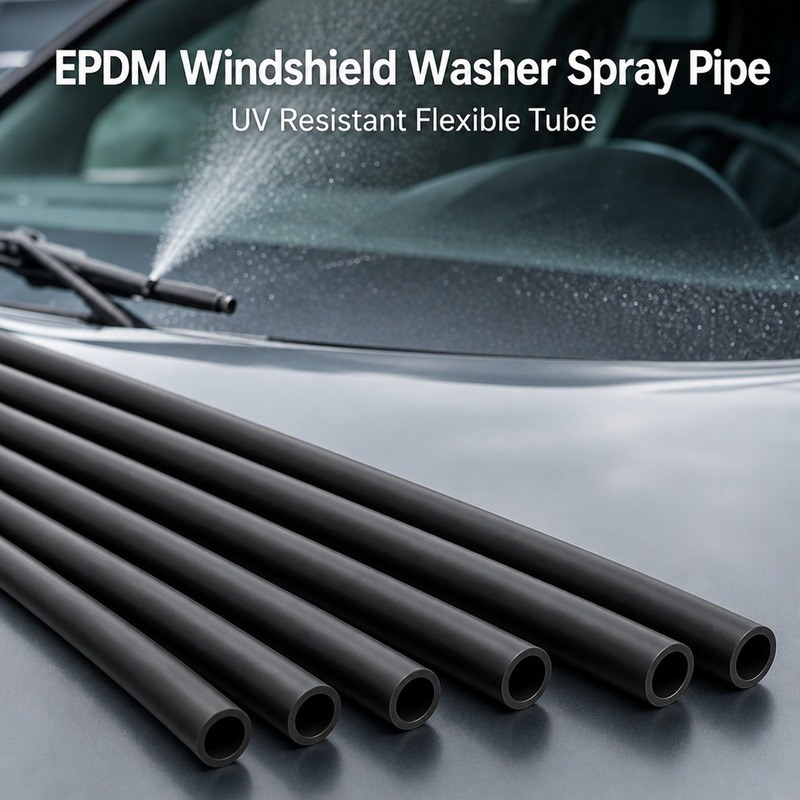
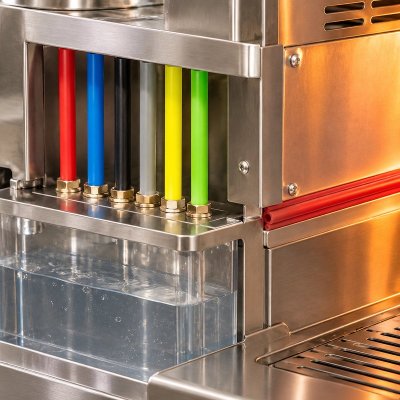
Flexible black EPDM hose for automotive fluid routing and condensate drainage.
Why B2B buyers are locking condensate-drain specs now
The equipment behind condensate drainage is a large and growing installed base. The global ventilation, heating, air-conditioning and commercial refrigeration equipment market grew from about USD 597 billion in 2025 to a projected USD 788 billion by 2030, a CAGR near 5.9%, with Asia-Pacific the largest region [5]. Every one of those air handlers, chillers, refrigerated cases and heat pumps produces condensate that has to leave the unit cleanly. For a component buyer, that means two things: steady aftermarket and program demand, and rising expectations on reliability and compliance as buildings and cold-chain assets are built to tighter efficiency standards [5].
Condensate itself is not aggressive, but the operating environment is: continuous moisture, warm temperatures, occasional cleaning chemicals, UV near outdoor units, and a service life measured in years. A generic hose that survives a bench test can still fail in the field because it was never specified for the real duty. That is why the drains in a commercial program are specified, qualified and traceable — not bought off a shelf.
Six B2B application fields — and what each buyer actually checks
The same drain hose serves very different customers. Understanding what each one cares about is the difference between a quote that gets a drawing and a quote that gets ignored.
- Automotive air conditioning & parts. The product's stated application field. The hose must flex with vehicle movement and vibration, tolerate under-hood heat and stay leak-free over the vehicle's life. Buyers check elongation, heat aging, ozone resistance and fit to the connector — not just nominal diameter.
- Commercial HVAC & air handlers.
Codes typically require a minimum line size and a continuous downward slope (commonly 1/8 inch per foot, about 1%) plus a trap on air-handler drains [3][4]. A flexible hose that routing can keep on grade — without sagging into low spots — directly reduces the blocked-drain and overflow calls that dominate service budgets [3][4]. - Commercial refrigeration & cold chain. Display cases and walk-in coolers generate steady condensate in a food environment. Buyers care about algae and slime resistance, clean inner walls, material compatibility with cleaning agents, and correct trap geometry for fan static pressure. Failed drains here create slip hazards and product-loss risk.
- Heat pumps & outdoor units. Heat pump equipment is one of the fastest-growing segments, and outdoor drain runs see sunlight, ozone and wide ambient temperatures [5][1]. EPDM's saturated backbone resists ozone, UV and weathering far better than unsaturated rubbers — the reason it is the default for outdoor and water service [1][2].
- Appliances & dehumidifiers. OEM appliance programs buy on consistency and cost per unit: uniform wall, repeatable cut length, custom colors for model coding, and a supplier who can hold a spec across production lots.
- Industrial equipment & dehumidification. Plant rooms and process equipment need a chemically compatible, kink-resistant drain that survives intermittent cleaning chemicals and long service intervals. Here the buyer's real question is material compatibility and failure-mode analysis, not price alone [4].
Across all six fields, a recurring industry analysis of condensate drain lines names the same failure modes — clogging from microbial growth or debris, standing water from wrong slope, and material degradation from chemical exposure — and the same procurement checks: current technical documentation, verified manufacturing capability, inspection readiness and supplier transparency [4]. Those four checks are a useful lens for any RFQ in this category.
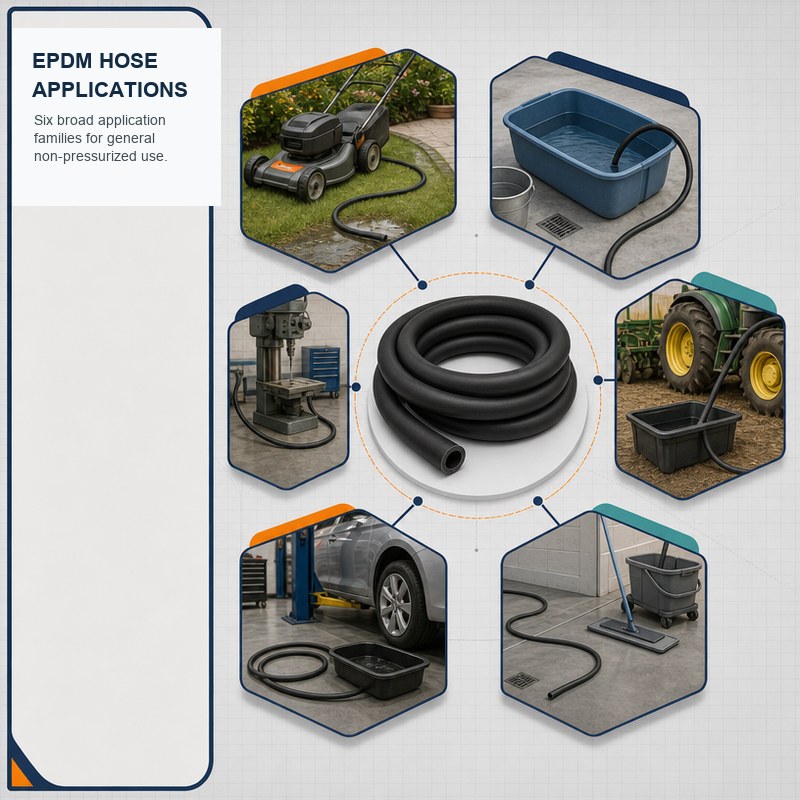
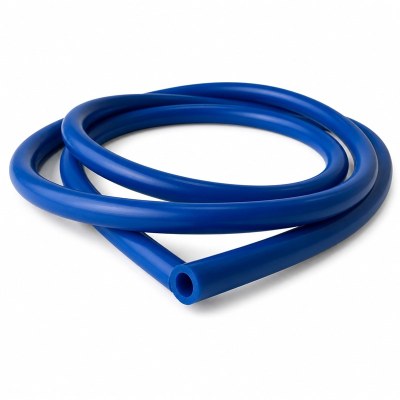
Six broad, non-pressurized EPDM hose application families.
Reading the spec sheet the way a buyer should
Condensate hose is often specified by a single number, which is how mistakes happen. The combination of inner diameter (ID) and outer diameter (OD) determines wall thickness, and wall thickness determines both flexibility and resistance to kinking — the two properties that decide whether a drain stays on grade. Confirm the measurement unit and the ID/OD pair together, not one or the other.
| Parameter | Product specification | Why the buyer cares |
|---|---|---|
| Material | EPDM (ethylene propylene diene monomer) | Ozone / UV / weather and water resistance [1][2] |
| Size | Φ4×8 mm or custom; ID/OD per drawing | Wall thickness sets flexibility and kink resistance |
| Working temperature | −40 °C to +125 °C (product rating) | Covers warm condensate and cold ambient starts |
| Hardness | 65±5 Shore A (per spec); customizable | Balances soft fit and shape retention |
| Tensile / elongation | ≥7 MPa / 350% | Indicates handling and flex-life margin |
| Structure | Braided-reinforced construction | Helps the hose resist collapse and hold its route |
| Duty | Gravity-fed condensate drain — atmospheric, non-pressurized | Match the hose to a drain duty, not a pressure duty [4] |
Independent EPDM data sheets put generic compounds at roughly 40–90 Shore A, tensile around 12 MPa and elongation near 350%, with excellent ozone/UV/weather and water/steam resistance but poor resistance to petroleum oils and fuels [1][2]. That last line is a procurement warning: a drain hose is right for water-based condensate and wrong for an oil or fuel line. If your assembly also carries oil, specify a different material — do not reuse an EPDM drain hose for it.
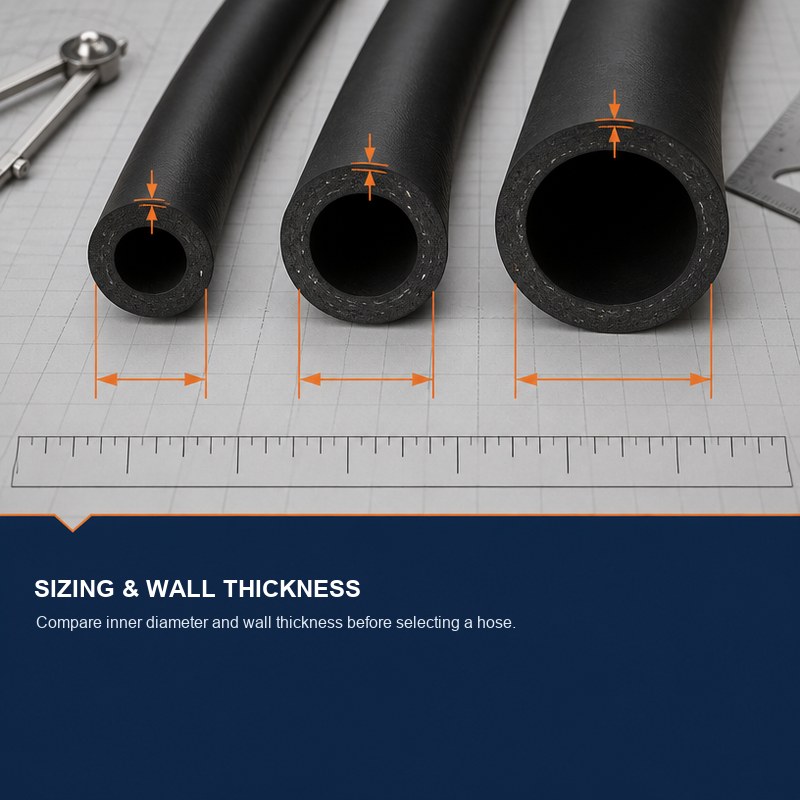
Compare inner diameter and wall thickness before selecting a hose.
Material choice: EPDM, and why substitutes fail outdoors
EPDM's saturated polymer backbone is the reason it dominates outdoor seals, HVAC gaskets, coolant and water service: it resists ozone, sunlight and weathering while handling hot water and steam within its compound limits [1][2]. For a condensate line that may run near an outdoor condenser or inside a sunlit plant room, that is exactly the failure mode to design against. NBR, by contrast, is chosen for oil resistance and performs poorly under ozone and UV — the wrong trade for an outdoor drain [1]. PVC is common in rigid drain pipework, but a flexible EPDM hose gives routing freedom where a rigid run cannot bend around a unit [3][4].
A note on temperature claims: the product is rated −40 °C to +125 °C. Published EPDM figures sometimes quote wider ranges for specialty peroxide-cured grades, but those are polymer-family guidance, not this product's rating [1]. Buy a hose on the rating of the actual grade and the conditions of your application — not on the widest number on a generic data sheet.
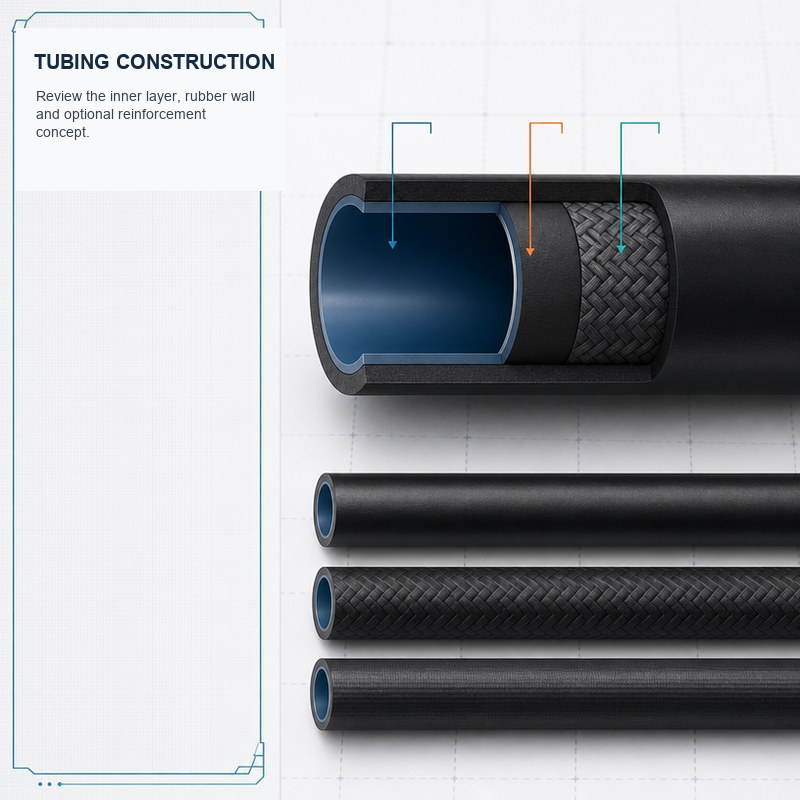
Inner layer, rubber wall and optional braided reinforcement.
Commercial terms a B2B buyer qualifies before sampling
Technical fit gets you to the sampling stage; commercial terms decide whether the program is viable. The published terms for this product are a useful baseline:
- MOQ. 100 metres for the standard item — low enough for a pilot build or a spares program, and consistent with a small-batch, fast-turn supplier model.
- Lead time. Around 3 days for a sample and 15 days for a batch order (with a 10-day general lead time also published), so a prototype-to-pilot schedule can be planned tightly.
- Customization. Length made to fully connect the loop, colors including black, white and pink, customer logo, and OEM/ODM — useful when different model codes or voltage variants need visual identification.
- Packing & logistics. Carton, PE bag, wooden pallet or paper roll; FOB Shenzhen / Guangzhou; L/C, D/A, D/P and Western Union terms. Confirm the exact packing and Incoterm against your receiving process.
- Price basis. Published pricing is indicative and final cost depends on design, material, surface treatment, quantity and packing — so issue a complete RFQ, not a one-line price request.
For a program buyer, the practical sequence is: send the drawing or a sample, confirm the ID/OD pair and material, approve a color and logo, qualify a sample, then lock the lot spec and packing before the first production order. Each step should produce a document you can tie to the delivered lot [4].
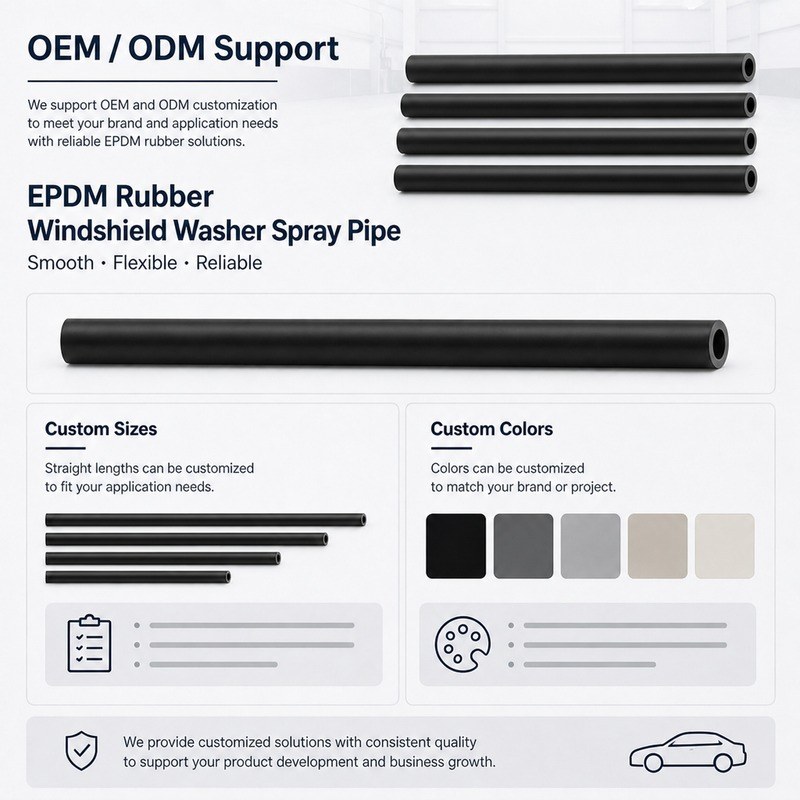
OEM/ODM support: custom sizes and colors to match your brand.
Qualifying the supplier, not just the hose
Industry procurement guidance for drain-line components recommends four evidence checks: technical documentation (current drawings, revision history, signed specification), manufacturing capability (equipment, process limits, capacity, production evidence), inspection readiness (test methods, calibrated equipment, sampling plans, traceable reports) and supplier transparency (legal entity, factory address, certifications, direct contacts) [4]. A low price with none of that evidence is not a saving — it is transferred risk.
RESRUB operates under IATF 16949, ISO 9001 and ISO 14001 management systems, with REACH and RoHS compliance, and has supplied automotive programs including BYD, Changan, Changan Ford and Yutong. The Dongguan plant runs its own laboratory for physical, chemical and mechanical testing, and its positioning is multi-variety, small-batch, short-lead-time work — MOQ from one piece, rapid tooling within about two hours, free design support and custom rubber colors. Ask for the documents that back each claim and match them to your lot; that is what turns a supplier's statement into an audit-ready record.
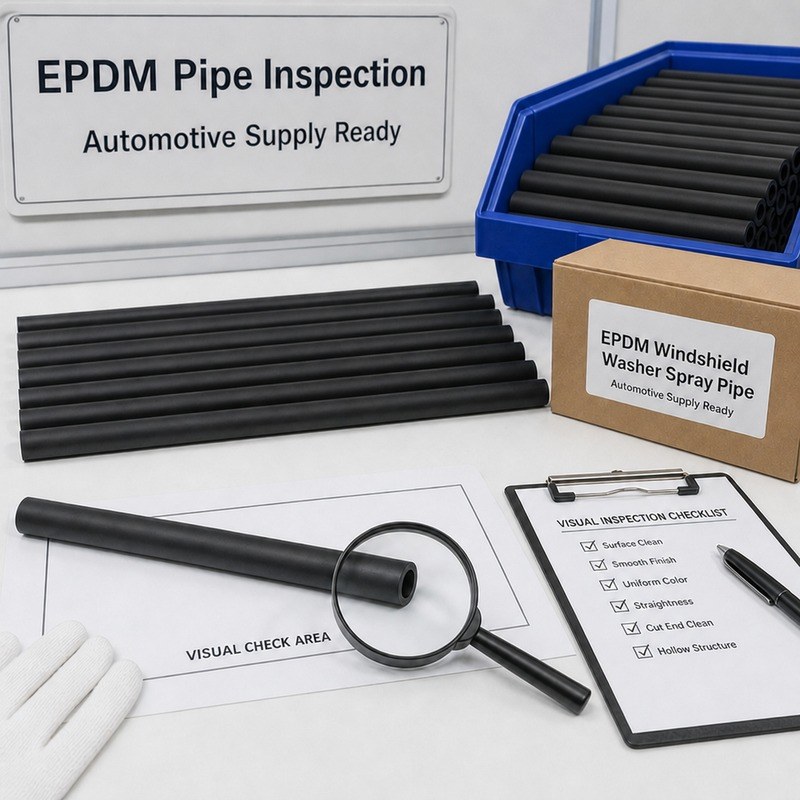
Visual inspection: surface, color, straightness and cut-end checks.
RFQ checklist for an EPDM condensate drain hose
| Item | What to put in the RFQ |
|---|---|
| Application field | Automotive / HVAC / refrigeration / heat pump / appliance / industrial; indoor or outdoor exposure |
| Dimensions | ID and OD together, wall tolerance, cut length, connector fit |
| Duty & environment | Gravity drain; condensate temperature, ambient range, UV, cleaning chemicals |
| Material | EPDM grade, hardness, tensile / elongation, relevant compliance documents |
| Commercial | Quantity, MOQ, target price, sample and batch lead time, packing, Incoterm, payment |
| Branding | Color reference, customer logo, printing / marking requirements |
| Evidence | Drawing revision, inspection plan, traceable lot report, certifications [4] |
Related reading
Small-Diameter Silicone Tubing for Precision Applications — how ID/OD tolerances and cure chemistry are verified on production lots;
Colored Silicone Foam Cord & Sealing Strip — how color, density and cell structure are controlled in custom extrusion.
References and further reading
- Strategic Sales Group (SSG) — EPDM rubber: typical service about −50 °C to +150 °C, 40–90 Shore A, excellent ozone / UV / weather and hot-water / steam resistance; swells in petroleum oils; standard for HVAC / appliance gaskets and coolant hoses.
- Truber Elastomers — EPDM Technical Data Sheet: 40–90 Shore A (65 typical), tensile 12 MPa, elongation 350%, compression set ≤30%, excellent ozone and water / steam resistance, poor petroleum-oil resistance; ASTM D2000 AA, WRAS / NSF-ANSI 61 / RoHS options.
- HVACore Tech — Condensate Drain Lines: Materials, Code Compliance & Molding: IMC / ASHRAE guidance — minimum line size, minimum downward slope around 1/8 inch per foot (≈1%), trap requirement on air handlers, and maintenance access.
- CNFX — Drain Line: gravity flow, atmospheric / non-pressurized duty, slope ≥1/8 inch per foot, FMEA on clogging / slope / material degradation, and a four-part procurement evaluation checklist (technical documentation, manufacturing capability, inspection readiness, supplier transparency).
- Research and Markets / The Business Research Company — Ventilation, Heating, Air-Conditioning and Commercial Refrigeration Equipment Market Report 2026: market from about USD 597 billion in 2025 to USD 788 billion in 2030 (CAGR ≈5.9%), Asia-Pacific the largest region.
Send your ID/OD, length, color, quantity and application field — or just a sample. Our engineers return a manufacturability review, a prototype and a quote — MOQ from one piece, rapid tooling within about two hours and free design support.
View Flexible and Heat-Resistant Rubber Hoses for Air Condenser Cooling Applications · Materials & process capabilities · Contact RESRUB