











PC Water-Cooling Tubing: The B2B Selection Guide for Heat, Noise and Reliability
For PC makers, workstation builders and server-thermal integrators, the tubing in a liquid-cooling loop is a small line item with an outsized influence on temperature, acoustics, reliability and warranty cost. This guide covers what Western buyers actually call these tubes, how to specify them, what goes wrong when you don't — and how a documented EPDM supply program de-risks the whole loop.
PC Water Cooling EPDM Tubing Server Liquid Cooling OEM / ODM
1. What Western buyers call "PC liquid-cooling tube"
Chinese spec sheets use a cluster of terms — 冷却液橡胶管, 液冷胶管, 水冷橡胶管, 散热胶管, 橡胶通液管, 服务器液冷管. Translated literally, several of these sound unnatural to an English-speaking engineer. To search, source and brief a Western team effectively, use the vocabulary the market already uses:
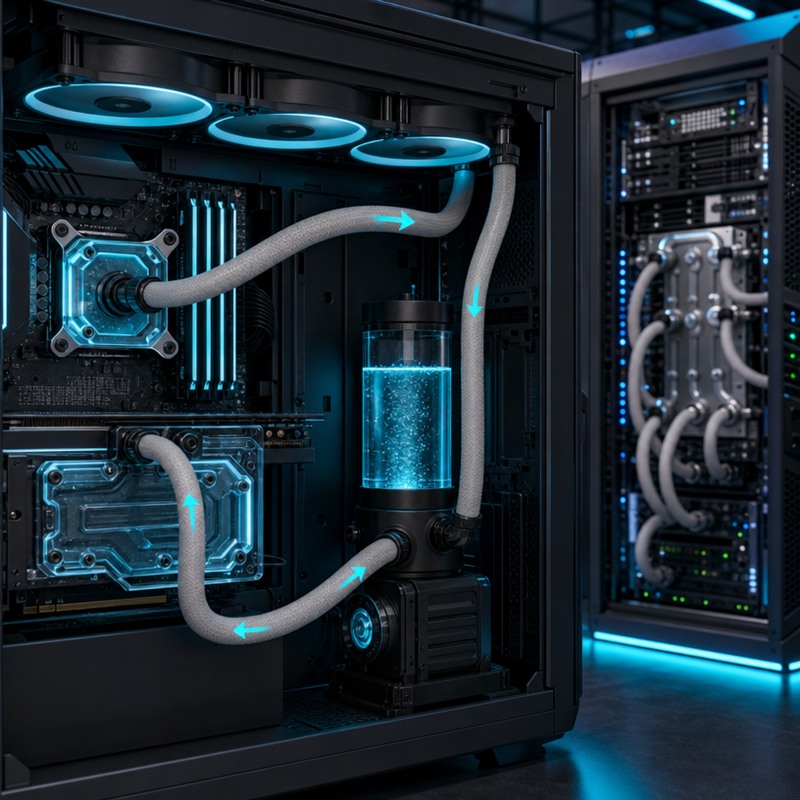
A soft-tubing PC water-cooling loop — the braided hose runs between pump, CPU/GPU water blocks, radiator and reservoir, the same coolant path discussed in this guide.
| 中文叫法 | Use this in English (EU / US) | Where it is used |
|---|---|---|
| PC液冷管 | PC water-cooling tubing / custom-loop tubing / soft tubing | The general, most-searchable terms for desktop enthusiast and OEM loops. |
| 水冷橡胶管 / 液冷橡胶管 | rubber water-cooling hose / EPDM water-cooling tubing | Material-specific B2B briefs and catalog categories. |
| 冷却液胶管 / 冷却液橡胶管 | coolant tubing / coolant hose | Engineering and procurement language; also covers coolant-transfer duty. |
| 服务器液冷管 | server liquid-cooling tubing / data-center coolant tubing | CDU / cold-plate distribution and server OEM programs. |
| 散热胶管 / 散热橡胶管 / 橡胶散热管 | cooling-loop tubing / radiator hose | Use "cooling", not the literal "heat-dissipation tube", which reads as machine-translated. |
| 橡胶通液管 | rubber fluid-transfer tubing | Industrial fluid handling and pump-fed loops. |
The word worth knowing: "ZMT"
In EU/US water-cooling communities, matte-black EPDM soft tube is widely sold as ZMT — "Zero Maintenance Tubing". It is not a resin grade but a market label for EPDM that, unlike clear PVC, does not leach plasticizer, cloud or yellow over time.[1][2][3] If you sell to Western OEMs or the aftermarket, "EPDM / ZMT-style tubing" is the phrase that signals the right product immediately.
2. Why the tube matters to the computer — measured effects
Cooling is no longer a comfort feature. Modern CPUs and GPUs are thermally constrained: they hold boost clocks only while temperature headroom remains. The loop tubing sits in the middle of that chain — a weak tube (kink, collapse, leachables, seepage) quietly erodes everything the pump, block and radiator were specified to deliver.
- Temperature & sustained performance. A 240 mm AIO typically lowers CPU temperature by roughly 10–15 °C versus a standard air cooler; in one high-end example an i9 under a 360 mm liquid cooler averaged about 65 °C versus ~80 °C on a premium air cooler — the difference between holding boost clocks and throttling.[4]
- Acoustics. Liquid systems move heat through larger radiators at lower fan speed; reported loads run about 30–35 dB for liquid versus 40–45 dB for air coolers, with the pump adding a low hum rather than rising fan whine.[4]
- Longevity & component stress. Running consistently hot shortens the useful life of silicon and can degrade solder joints, VRM and capacitors. A stable, cool loop reduces thermal cycling stress — which is precisely where an aging or hardening tube becomes the weak link.
- Fluid integrity & safety. Clear PVC soft tube is known to leach plasticizer, cloud and yellow; deposits and swollen inner walls restrict flow and can foul a block's micro-channels. EPDM is chosen because it is essentially maintenance-free and chemically inert to common water-based coolants.[1][2][3]
Where the tube sits
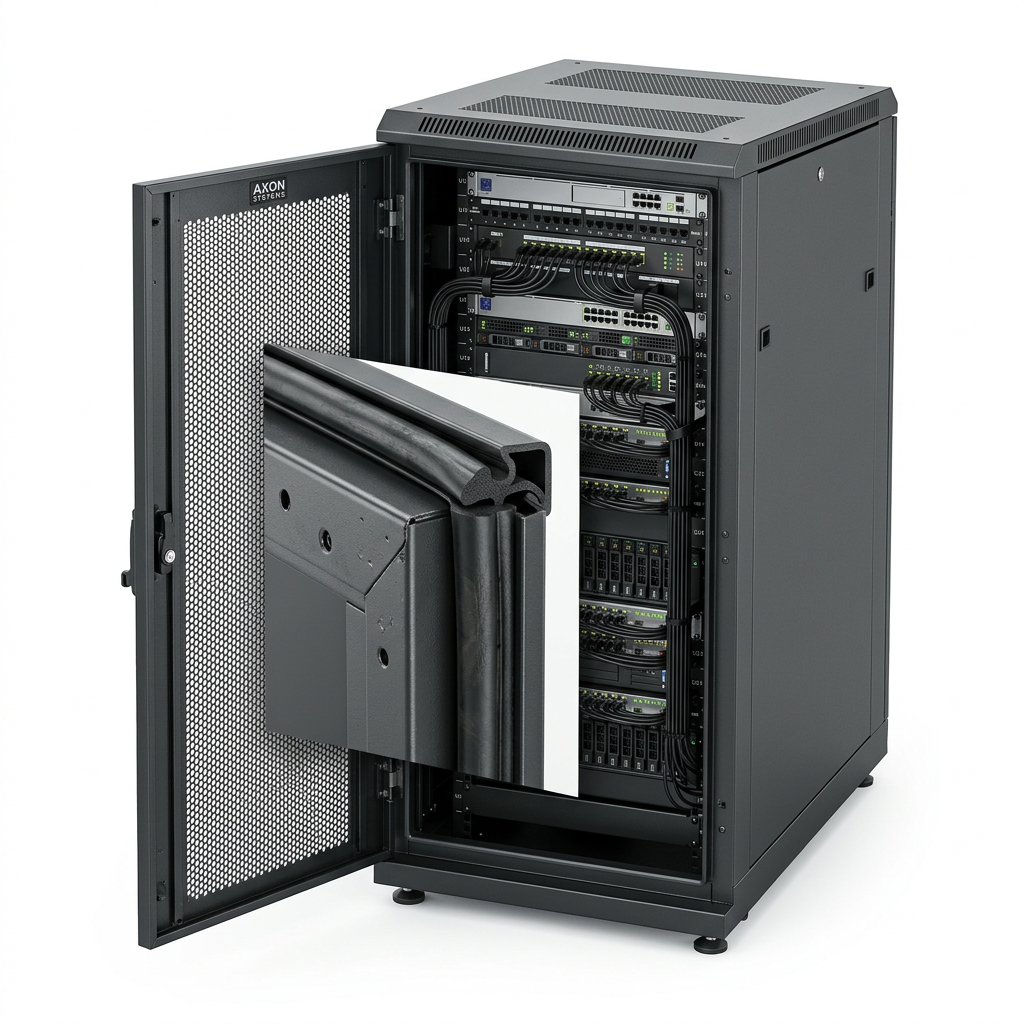
The same coolant-path discipline applies at both scales: a desktop custom loop (pump → CPU/GPU block → radiator → reservoir) and a server cold-plate loop (CDU → cold plate → return). In each, braided soft tubing carries low-pressure coolant between modules.
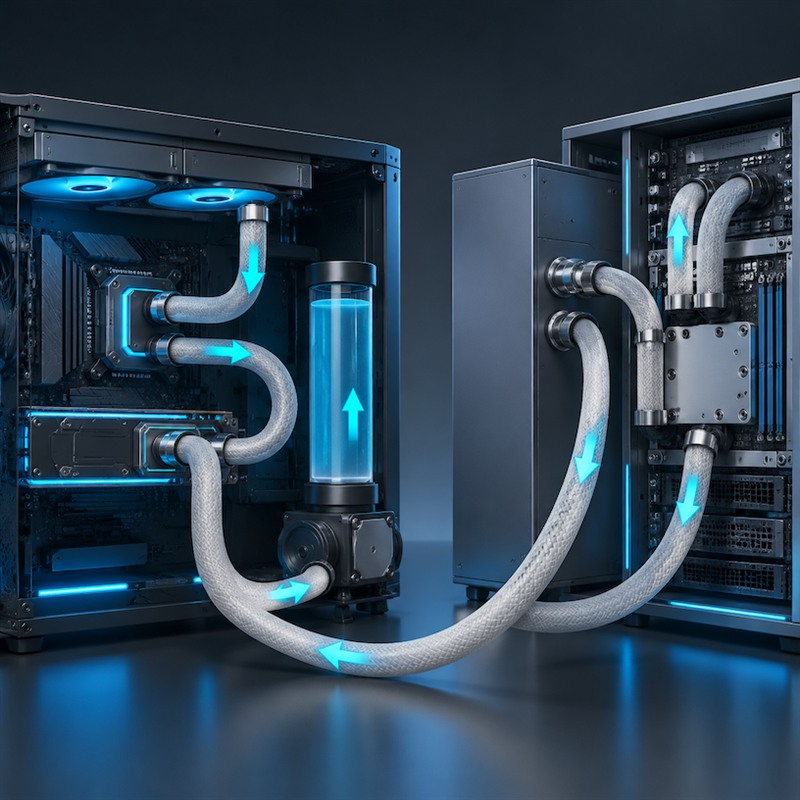
From gaming / workstation PCs to server cold-plate loops — braided soft tubing serves both the desktop custom loop and the rack-scale coolant distribution path.
3. The selection criteria that decide loop life
Soft tubing is forgiving, but only inside its envelope. For a B2B build — where a leak means an RMA, not a weekend project — these are the parameters to lock on the drawing.
3.1 Material & cure chemistry
- Prefer EPDM for a low-maintenance, opaque, long-life loop: it resists heat, ozone and water-based coolants without plasticizer.[1][2] Where visual coolant monitoring is required, clear PVC or silicone is an option — with a documented coolant-compatibility check and a shorter replacement interval.
- Prefer platinum-cured silicone when the tube must stay clear and flexible across a wide temperature range; avoid peroxide-cured material where odor or extractables matter.
- Avoid unbranded PVC with no material, temperature or pressure data — the most common source of clouding, swelling and coolant contamination in the field.[3]
3.2 Size: ID, OD and wall thickness
Western sizing is written ID/OD in millimetres (e.g. 10/16 mm) or in inches (3/8" ID). The most common desktop sizes are 8/10, 10/13, 10/16 and 13/19 mm; 10/16 mm is widely treated as the all-round default.[1][2][5]
- ID governs flow; differences between standard sizes are usually minor once the block and fittings are the real restriction.[2]
- OD must match the compression or barb fitting exactly — metric and imperial parts are not interchangeable by appearance.[5]
- Wall thickness sets flexibility and kink resistance: thicker walls resist kinking and collapse but are stiffer to route; thinner walls bend easily but can sag on long runs.[2]
3.3 Bend radius, kinking and routing
Plan the route before cutting. Keep bends gentle and supported; use angled fittings or an anti-kink coil where space forces a tight turn. A flattened tube raises resistance and can starve a high-flow GPU block. Leave service loops for panel removal and reservoir access.[2][5]
3.4 Coolant compatibility, temperature and evaporation
- Check the tube against the coolant's Safety Data Sheet and run a simple 48-hour soak test at operating temperature; inspect for swelling, discoloration, tackiness or odor before committing a full loop.[5]
- Keep the operating target modest (a common design ceiling cited for soft tube is around 60 °C) and verify burst rating rather than trusting appearance.[5]
- Evaporation / mass loss matters over years. RESRUB's published PC liquid-cooling rubber hose reaches a low evaporation figure of 0.2%[7] — the kind of spec that protects coolant level and pump prime in a sealed or long-interval loop. Verify the current test report for the exact compound and lot.
3.5 Fittings and installation discipline
Cut square with a sharp tubing cutter, deburr, push fully over the barb, and secure with the correct clamp. Most field leaks trace to a poor cut, a mismatched fitting or an unseated tube — not to catastrophic material failure.[5]
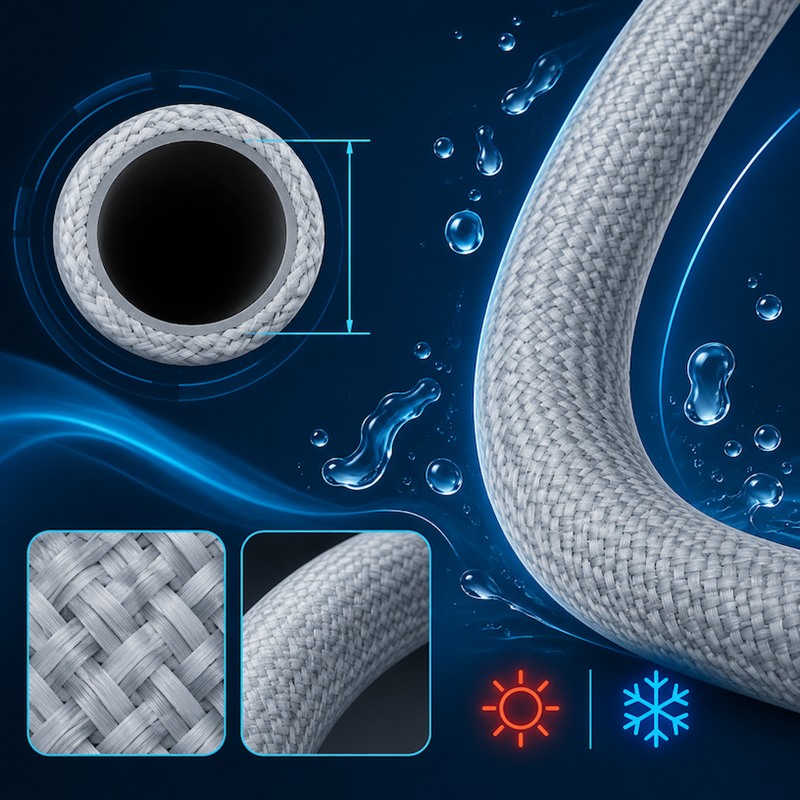
Anatomy of braided soft tubing — inner bore, wall, braided jacket and temperature symbols: these are the dimensions and ratings to lock on the drawing.
4. Failure-mode map: what sloppy specs cost you
| Variable ignored | Field symptom | Downstream consequence |
|---|---|---|
| Wrong material (unbranded PVC, peroxide-cured, unknown compound) | Plasticizer leach, clouding, yellowing, odor, swelling | Restricted flow, fouled micro-channels, coolant changes, RMA and brand damage |
| Wrong dimension (ID/OD/wall out of tolerance, metric/imperial mix) | Weep at fittings, kink, sag, unstable flow | Leak events, pump starvation, thermal throttling under load |
| Wrong process / no documentation (no lot traceability, no compatibility data) | Batch-to-batch variation, no root cause | Line-stop, recall exposure, cannot close a quality loop |
A tube that costs a few cents more per unit is the cheapest insurance against an RMA that ships a whole system back — and, in a server program, against the service call that follows.
5. The market signal: why this is a B2B growth line
Liquid cooling has moved from enthusiast niche to infrastructure default. TrendForce projects liquid cooling penetration in AI chips rising from about 33% in 2025 to 53% in 2026 and nearing 60% in 2027; global AI data-center liquid-cooling penetration is put at roughly 14% (2024) → 33% (2025) → ~40% (2026).[6] China's liquid-cooling data-center market reached RMB 15.98 bn in 2025 (+45.2%) and is forecast at RMB 23.25 bn in 2026 and RMB 47.04 bn by 2028.[6]
For a component supplier that means one thing: the tube is no longer an accessory bought in a rush at the end of a build. It is a specified, documented, repeat-purchase line item — exactly the kind of program that rewards a supplier with flexible MOQs, fast tooling and certified quality.
53% AI-chip liquid-cooling penetration, 2026F (TrendForce)[6] · 0.2% RESRUB published evaporation figure, PC liquid-cooling hose[7] · 10 in-house braiding machines for reinforced liquid-cooling hose[7]
6. The RESRUB approach — hazard to solved problem
RESRUB (Dongguan Xingfeiyu Rubber And Plastic Products Co., Ltd.) builds EPDM and silicone tubing for exactly these low-pressure coolant loops — backed by a certified quality system and a flexible manufacturing model that fits how hardware teams actually develop products.
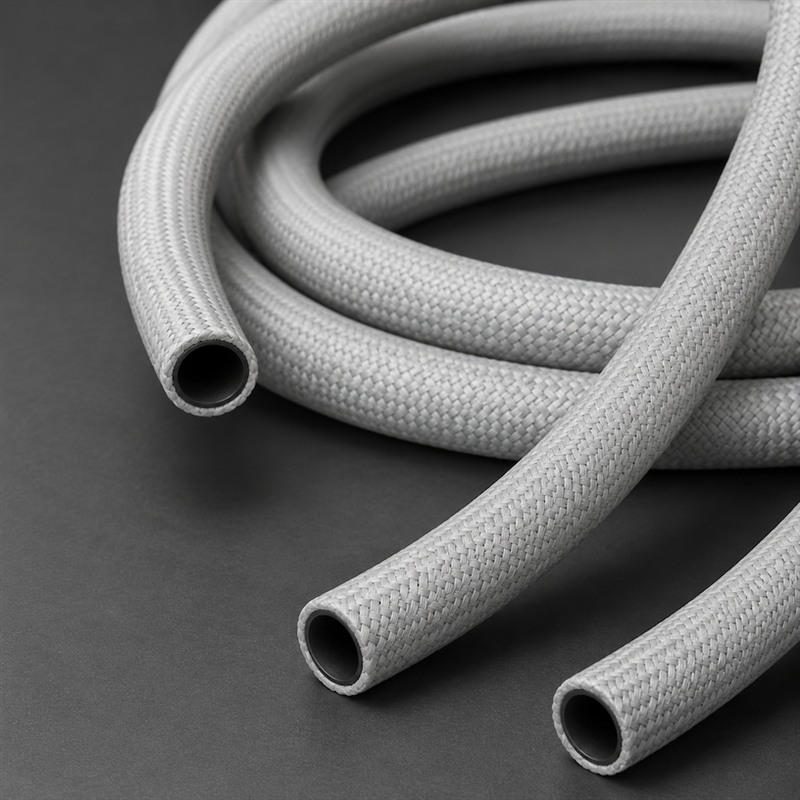
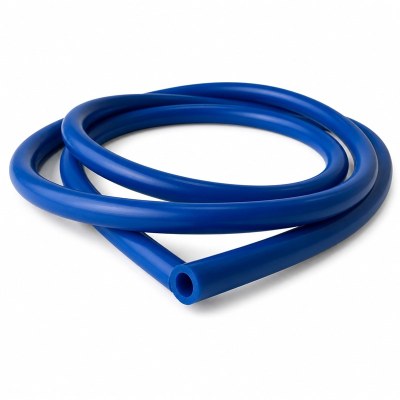
Braided-reinforced EPDM / silicone water-cooling tubing — smooth inner bore and a braided jacket for dimensional stability under pump pulsation and tight routing.
| Your risk | How RESRUB addresses it |
|---|---|
| Leaching / clouding / odor | EPDM compounds chosen for water-based coolants; no plasticizer needed by the chemistry; silicone options in platinum cure; documented, traceable feedstock. |
| Kink, collapse, dimension drift | Tight extrusion tolerances and consistent wall; optional braided-reinforced cooling hose for dimensional stability, produced on an in-house 10-machine braiding line.[7] |
| Evaporation / fluid loss over time | Low-evaporation PC liquid-cooling rubber hose (published figure 0.2%) to protect coolant level in long-interval loops.[7] |
| Compliance & traceability gap | Quality system certified to IATF 16949:2016, ISO 9001:2015, ISO 14001:2015; REACH / RoHS declarations; per-lot documentation and an in-house lab for physical, chemical and fatigue testing.[7] |
| Prototype & supply risk | MOQ 1 piece, 2-hour rapid tooling, free R&D design, custom sizes / hardness / colors, short lead time for small batches — validate before you commit volume. |
A related EPDM program: chemical-resistant pump tubing
The same compound discipline — precise wall tolerance, ozone and chemical resistance, long fatigue life under repeated flexing — also underpins RESRUB's industrial fluid-handling line. If your application extends from the PC loop to dosing or coolant transfer, see the EPDM Peristaltic Pump Tubing — Chemical Resistant Rubber Hose for Industrial Pumps OEM/ODM (model RESRUB-PP-EPDM-08): industrial-grade EPDM, ID 4–25 mm, 65–70 Shore A, resistant to acids, alkalis, coolant, detergent and alcohol, with OEM/ODM sizing and branding. For the PC loop specifically, compare the Black EPDM Rubber Hose for PC Water-Cooling Loop.
What this means for your program
You get a coolant-path component that stays dimensionally stable under pump dynamics, is chemically quiet against common coolants, is documented for the markets you sell into, and is supplied on terms that let engineering actually test and iterate instead of compromising.
7. A sourcing checklist for PC / server programs
- Vocabulary: specify "PC water-cooling tubing / EPDM ZMT-style soft tube"; for servers use "server liquid-cooling tubing".
- Material: EPDM (low-maintenance, opaque) or platinum-cured silicone (clear, wide temperature); state the compound, not just "rubber".
- Dimensions: ID/OD in mm (or exact inch ID), wall thickness, concentricity, hardness (Shore A) — and confirm the fitting standard matches.
- Coolant compatibility: cross-check the coolant SDS and run a 48-hour soak test at operating temperature.[5]
- Temperature & evaporation: confirm the working range and the evaporation / mass-loss figure on the current test report.[7]
- Bend radius & routing: verify it survives your tightest bend without kinking; plan service loops.
- Reinforcement: specify braided if the run sees suction, pulsation or long unsupported spans.
- Documentation: per-lot CoA, REACH / RoHS declaration, certified quality system (IATF / ISO), in-house test capability.
- Commercial terms: low MOQ and rapid tooling so you can validate before volume — and request samples of both the standard and reinforced builds.
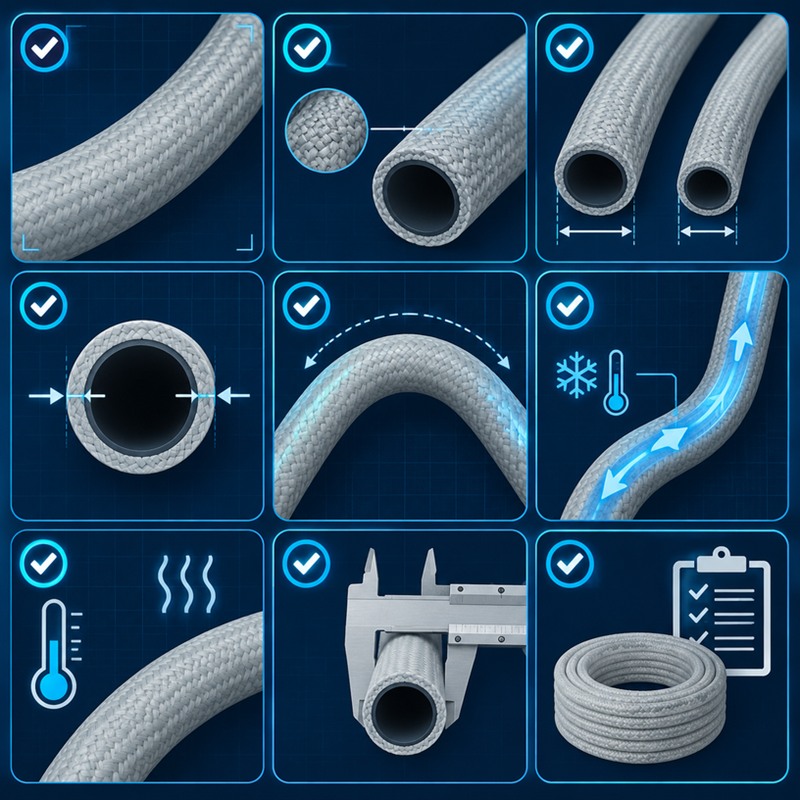
The sourcing checklist at a glance — material, ID/OD, wall, bend radius, flow, temperature, compatibility, measurement and supply, for procurement and thermal-engineering teams.
8. Keep the loop in the family — related reading
To close the knowledge loop, these RESRUB resources go deeper on the same program:
- Braided Hose Sample Validation for PC Liquid Cooling Loops — how to qualify a reinforced tube before release.
- Rubber Tubing Solutions for Liquid Cooling and Fluid Routing — material and route selection across applications.
- Braided Hose Assembly Guide: Specifying Pressure, Bend Radius and OEM Fittings — assembly-level detail for OEM builds.
- RESRUB PC Liquid Cooling Tube Solutions — the dedicated solution page for gaming PC cases.
- Browse the full Rubber Hoses catalog — standard and custom tubing families.
9. Conclusion
Liquid cooling is now a specified, growing B2B line — and the tube is the quiet determinant of whether the loop delivers its promised temperature, noise and service life. Get the vocabulary right, specify material, ID/OD, wall and coolant compatibility explicitly, and verify evaporation and documentation. For hardware teams that need small batches, quick iteration and certified supply, RESRUB's EPDM and silicone tubing program is built to de-risk the loop from sample to volume.
Building or upgrading a PC, workstation or server cooling loop?
RESRUB supplies EPDM / silicone water-cooling tubing — including braided-reinforced options — with IATF 16949 / ISO 9001 / ISO 14001 certified quality, MOQ 1, rapid tooling and per-lot documentation. Contact our team to specify the right tube for your loop.
References
- Water Cooling UK, "Hose Type and Size Explained" — soft tubing materials (PVC / EPDM / silicone), ID/OD sizes 8×10, 10×13, 10×16, 13×19 mm. watercoolinguk.co.uk
- Titan Rig, "Water Cooling Components — Tubing" — tubing materials (PVC, polyurethane, EPDM, TPV), EPDM essentially maintenance-free and opaque, wall-thickness effects on flexibility and kinking. titanrig.com
- FTC Water Cooling, "Beginner Guide: Soft Tubing vs. Hard Tubing — 2026 Build" — the rise of EPDM / "ZMT (Zero Maintenance Tubing)", no plasticizer leach, no clouding vs. clear PVC. ftcwatercooling.com
- A2Z Computech, "Is Liquid Cooling Worth It for PCs in 2025?" — 240 mm AIO ≈10–15 °C below air; i9 at ~65 °C (360 mm liquid) vs ~80 °C (air); noise ~30–35 dB vs 40–45 dB. a2zcomputech.com
- LaptopJudge, "Soft Tube Water Cooling (Tubing Selection)" — ~60 °C operating target, ≥1.5 bar burst guidance, 48-hour soak compatibility test, 10/16 mm and 3/8" sizing. laptopjudge.com
- TrendForce projections and CCID (赛迪顾问) market data reported by 中国经济网 / 大众证券网 (2026) — AI-chip liquid-cooling penetration 33% (2025) → 53% (2026F) → ~60% (2027F); China liquid-cooling data-center market RMB 15.98 bn (2025, +45.2%), 23.25 bn (2026F), 47.04 bn (2028F). ce.cn · dzzq.com.cn
- RESRUB / Dongguan Xingfeiyu published product & capability data — PC liquid-cooling rubber hose evaporation figure 0.2%; 10 in-house braiding machines; IATF 16949:2016 / ISO 9001:2015 / ISO 14001:2015 certified quality system; REACH / RoHS declarations. resrub.com
RESRUB is the overseas brand of Dongguan Xingfeiyu Rubber And Plastic Products Co., Ltd. RESRUB is not affiliated with, endorsed by, or sponsored by any brand named herein; brand names are cited solely as factual references to publicly reported studies, market data and product documentation. Market figures are third-party projections and are not guarantees. The evaporation figure and production capabilities are RESRUB-published values — verify the current test report and lot documentation before specification. Tubing here is described for low-pressure liquid-cooling circuits, not as high-pressure hose. ZMT is used as a market term for EPDM soft tubing and is not a RESRUB trademark.